
Applications — Compliance & Regulatory Intelligence
The rules move. Your reading shouldn't lag.
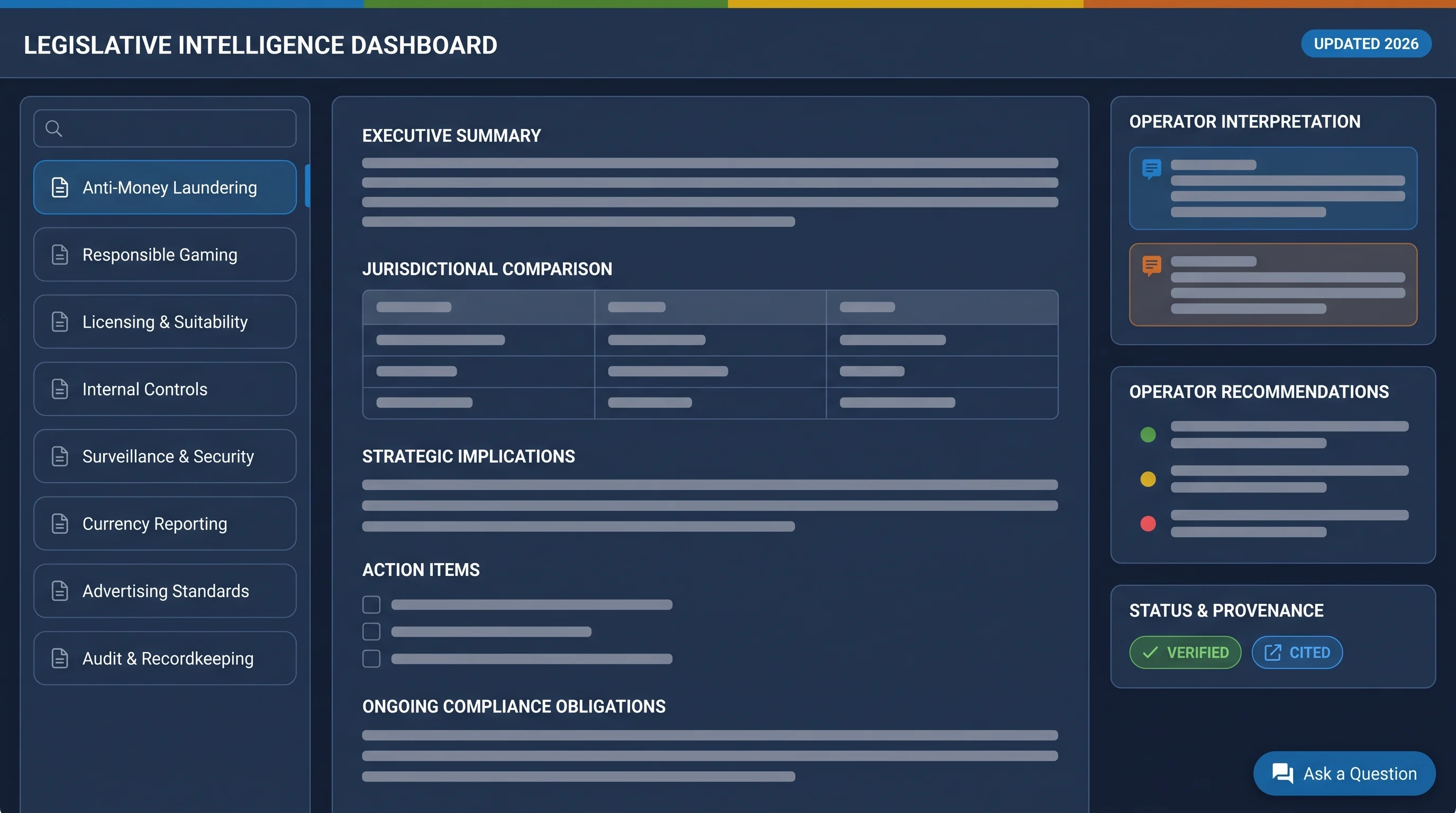
Benchmark Compliance & Regulatory Intelligence keeps the rules that matter current, cited, and operationally clear — what changed, what it affects, and what your team needs to do next.
Gaming regulation is a moving operational system. Statutes, regulations, technical standards, license conditions, AML and responsible-gaming requirements, internal controls, and regulator guidance together determine how a property may be designed, opened, and operated. A static memo goes stale while the decision it supports is still on the table.
Compliance & Regulatory Intelligence is the maintained answer: when a rule, standard, interpretation, or filing requirement moves, your team sees the controlling source, the operational impact, and the actions that follow — without waiting for the next memo cycle to catch up.
The full regulatory stack
Licensing statutes, regulations, technical standards, AML and responsible-gaming requirements, internal controls, and regulator notices — organized together, with every analysis cited and date-stamped.
Verified before it reaches you
Every reading is checked against the applicable primary authority before your team sees it. No uncited summary or unverified interpretation is treated as settled.
Read from the operator’s seat
The interpretation layer is written by principals who have opened and run integrated casino-resorts — what a clause changes on a gaming floor, in a staffing plan, on a timeline. Operational interpretation, distinct from legal advice.
The license is the constraint. Operations are the work.
Compliance work starts before an application and continues through every operating day. Design decisions must satisfy technical and surveillance standards; vendors and key people must clear licensing; systems must support reporting, AML, responsible gaming, and approved controls. Wherever your team sits in that chain, the regulatory reading has to connect directly to the decision in front of you.
- Operators carrying live licensing, internal-control, AML, and responsible-gaming obligations
- Developers and owners translating regulatory requirements into design, systems, staffing, and opening plans
- Suppliers and vendors navigating licensing, certification, and market-entry requirements
- Law firms and regulatory counsel whose clients need the operational meaning behind the rule
- Lenders and underwriters pricing regulatory and licensing risk
- Bid, transaction, and diligence teams assessing a jurisdiction before committing capital
Managing regulatory exposure?
Tell us the jurisdiction, project stage, and decision in front of you. A principal will walk through the current requirements from the operator's seat.
Discuss your projectBuilt like something a regulator will read.
Named, logged access
Every seat is a named login, and access is logged. The statutory corpus and analysis stay server-side — nothing ships as a file that walks away.
Cited or not stated
The system refuses to state anything it cannot cite. Citations attach only to verified provisions; the claim that cannot quote its source does not ship.
Dated, bounded, accountable
Every analysis carries its date and its basis. Deliverables are operational advisory, not legal advice, and say so.
Access is gated and scoped in a conversation, not a checkout page. Clients engage two ways. Some teams need to know what the law now says; that is the monitoring relationship. Others need to know what to do about it; that is analyst access, with the operator who has opened these properties working out what a rule means for your project.